

-
Why Are Foot Jokes So Easy to Share With Friends and Family?
I have always thought that the simplest jokes can sometimes be the most entertaining. You do not need a complicated story or a clever setup to make someone laugh. Sometimes one unexpected word is enough. That is probably why jokes about ordinary things can work so well. Feet are a good example because everyone has them, everyone uses them, and there are so many everyday words connected with walking, shoes, socks, toes, heels, and steps.
What makes this kind of humor interesting is that it can fit into many different situations. A joke about shoes can be used in a casual conversation, while a short toe joke can work as a caption or a quick message to a friend. The humor is usually easy to understand, which makes it suitable for people who enjoy simple wordplay rather than complicated comedy.
I also think the language around feet gives writers a lot of material. Words such as sole, heel, toe, arch, step, walk, shoe, and sock can be used in different ways. Some of them sound similar to other words, while others already appear in common expressions. This makes it easy to turn an ordinary sentence into something playful without changing it too much.
For example, the word “sole” can immediately make someone think of a shoe or the bottom of a foot, but it also sounds like “soul.” That simple connection can create several different jokes. The same thing happens with words such as “heel” and “heal.” These small language connections are what make foot humor interesting.
Another reason this type of humor works is that it does not require much background knowledge. If someone makes a joke about a complicated subject, you may need to understand the topic before you can appreciate it. Foot humor is different. Most people already understand what a shoe, sock, toe, or heel is. Because of that, the joke can get to the funny part quickly.
I recently started paying more attention to feet jokes because they seem to appear in so many different forms. Some are short one-liners, while others are questions and answers. There are also jokes that focus on shoes, running, dancing, walking, or everyday situations. The variety means people can find something that matches their own sense of humor.
One thing I like about short jokes is that they are easy to remember. If a joke is only one sentence long, there is no need to read a long explanation before sharing it. You can tell it to someone at lunch, send it in a group chat, or use it as a funny caption. Short jokes are especially useful online because people often prefer content that they can understand within a few seconds.
Foot humor can also be useful when someone wants to make a conversation less serious. Imagine a group of friends talking after a long day. Instead of trying to come up with a complicated topic, someone can make a simple joke about being tired from walking all day. It may not be the greatest joke ever created, but it can still make everyone smile.
There is also something naturally funny about shoes. People have different opinions about them, and everyone has probably experienced a shoe that was uncomfortable, too tight, too loose, or simply not suitable for a particular occasion. Someone wearing brand-new shoes for the first time might have a completely different experience from someone wearing the same pair for years.
Socks provide another easy source of humor. Everyone has probably lost a sock in the laundry at some point. Somehow, one sock disappears while the other one remains behind. This ordinary experience can become a funny conversation because almost everyone understands it. You do not need a special story to create a joke from something so familiar.
Toes can also inspire playful word choices. Their names and positions make them easy to include in silly questions or short jokes. The humor does not need to be clever in a serious way. In fact, the sillier the joke, the better it can sometimes work. There is something enjoyable about deliberately using a terrible pun and knowing that everyone understands how cheesy it is.
I think that is an important part of pun-based humor. A good pun does not always need to be sophisticated. Sometimes people laugh because the joke is predictable. They know exactly where the sentence is going, but the wording still makes them smile. This is especially true when the pun uses a familiar phrase and changes one word.
Another interesting thing about foot jokes is how easily they can be adapted for different occasions. A birthday message could include a playful line about taking another step into a new year. A running friend might enjoy a joke about sore feet after a long race. Someone buying new shoes could make a funny comment about finally finding the right pair. These small connections make the humor feel more personal.
Social media has probably made this kind of humor even more common. People constantly look for short captions that can match photos or everyday moments. A picture of new shoes, a hiking trip, a beach walk, or a funny sock can all create opportunities for a simple joke. The best captions are often short enough that people understand them immediately.
Of course, not every pun is going to make everyone laugh. Humor is personal. One person might love a simple toe joke while another person thinks it is too cheesy. I actually think that is part of the fun. Some jokes are so silly that they become funny simply because they are bad. When friends are already in a relaxed mood, those jokes can work surprisingly well.
There is also a nice family-friendly quality to many foot-related jokes. Parents can share simple shoe or toe jokes with children, friends can use them in casual conversations, and people can post them online without needing a complicated setup. Clean humor can sometimes be harder to write because the joke has to depend on wordplay rather than shock value, but foot-related vocabulary gives plenty of options.
For people who enjoy writing jokes themselves, feet can be a good subject to experiment with. Start with a common foot-related word and think about other words that sound similar or phrases that contain it. Then try changing the meaning while keeping the sentence natural. The goal is not necessarily to create the funniest joke ever. It is simply to find a line that sounds unexpected enough to make someone smile.
It can also help to say the joke out loud. Some puns look clever when written but do not sound funny when spoken. Others work much better when heard because the two meanings sound exactly the same. Reading the joke aloud can quickly show whether the wordplay feels natural or forced.
In the end, I think foot humor remains popular because it is simple, relatable, and flexible. Everyone walks, everyone wears shoes at some point, and almost everyone has a funny experience involving socks, toes, or uncomfortable footwear. That gives people plenty of everyday situations to turn into jokes.
Sometimes we take humor too seriously and start looking for complicated ideas when a simple joke would do the job. A small pun about a shoe or a silly line about walking can be enough to change the mood of a conversation. That is probably the biggest reason I enjoy this type of humor. It does not need a big setup. You can simply find an ordinary word, give it an unexpected meaning, and take the conversation in a funny direction.
cowpuns.com
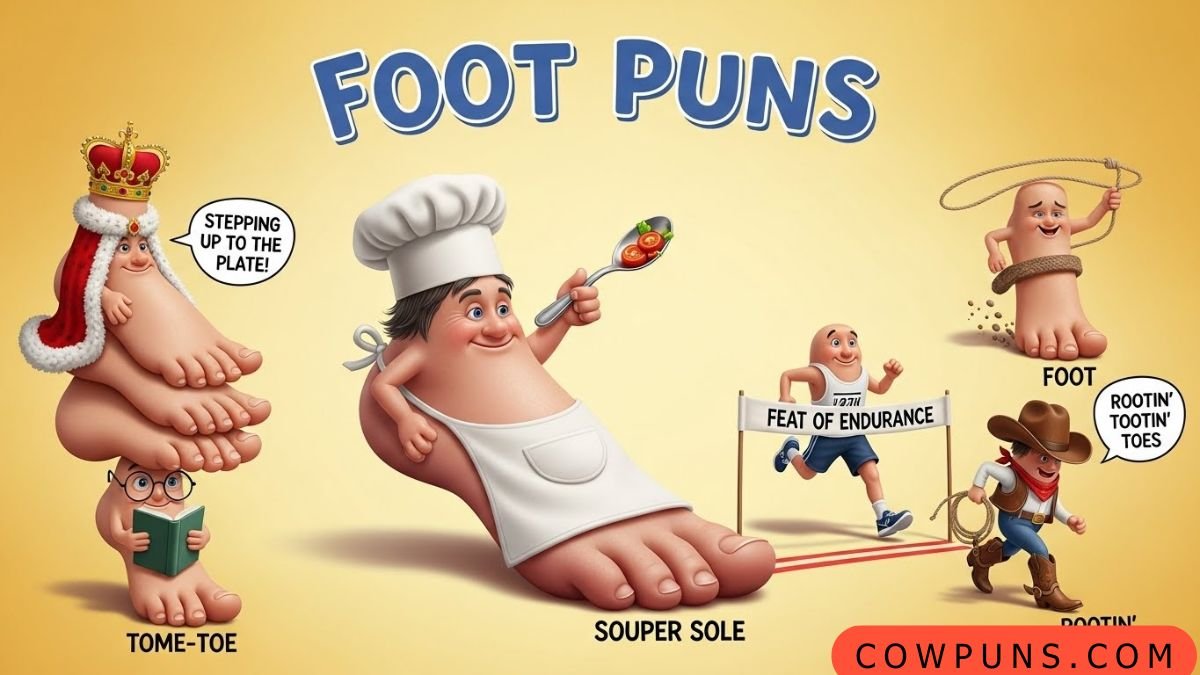
350 Foot Puns: The Ultimate Collection of Hilarious Foot Jokes and Toe-Tickling Wordplay
Enjoy Foot Puns with funny foot jokes, toe puns, heel humor, and sole wordplay for captions, birthdays, and everyday laughs in one fun guide.
Sorry, there were no replies found.
Log in to reply.